MEMORIES
MEMORIES
In old age you are supposed to be happy with your memories. But in the end, everything ends up in the skip.
f7129f15-b20e-4c07-abd7-36c92c5424bc_904x722.png
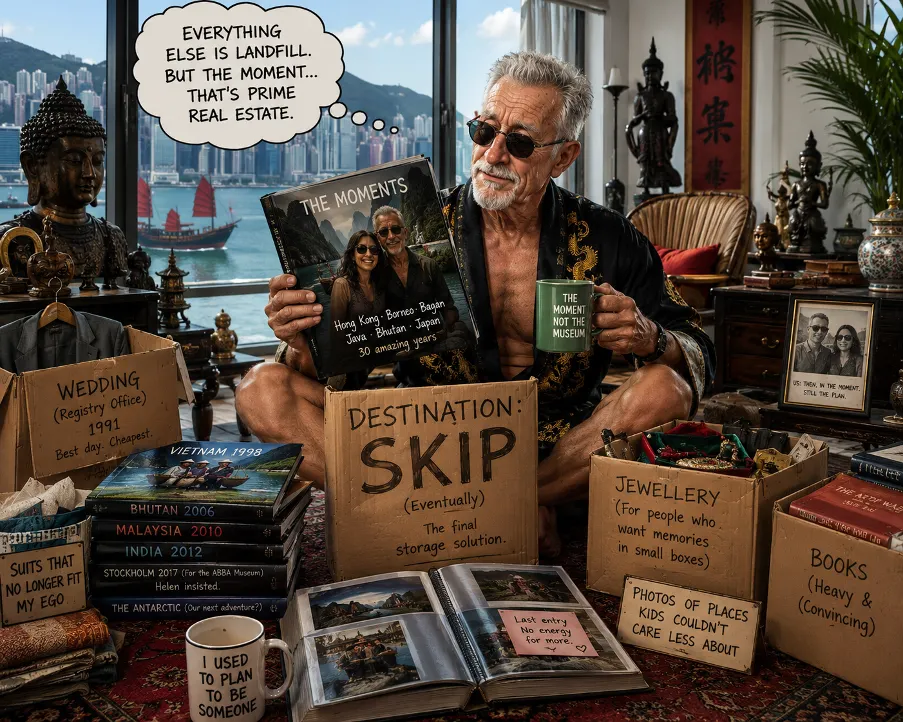
It is one of the irritations of life that people keep telling you that old age will be full of memories. This is apparently meant to cheer you up.
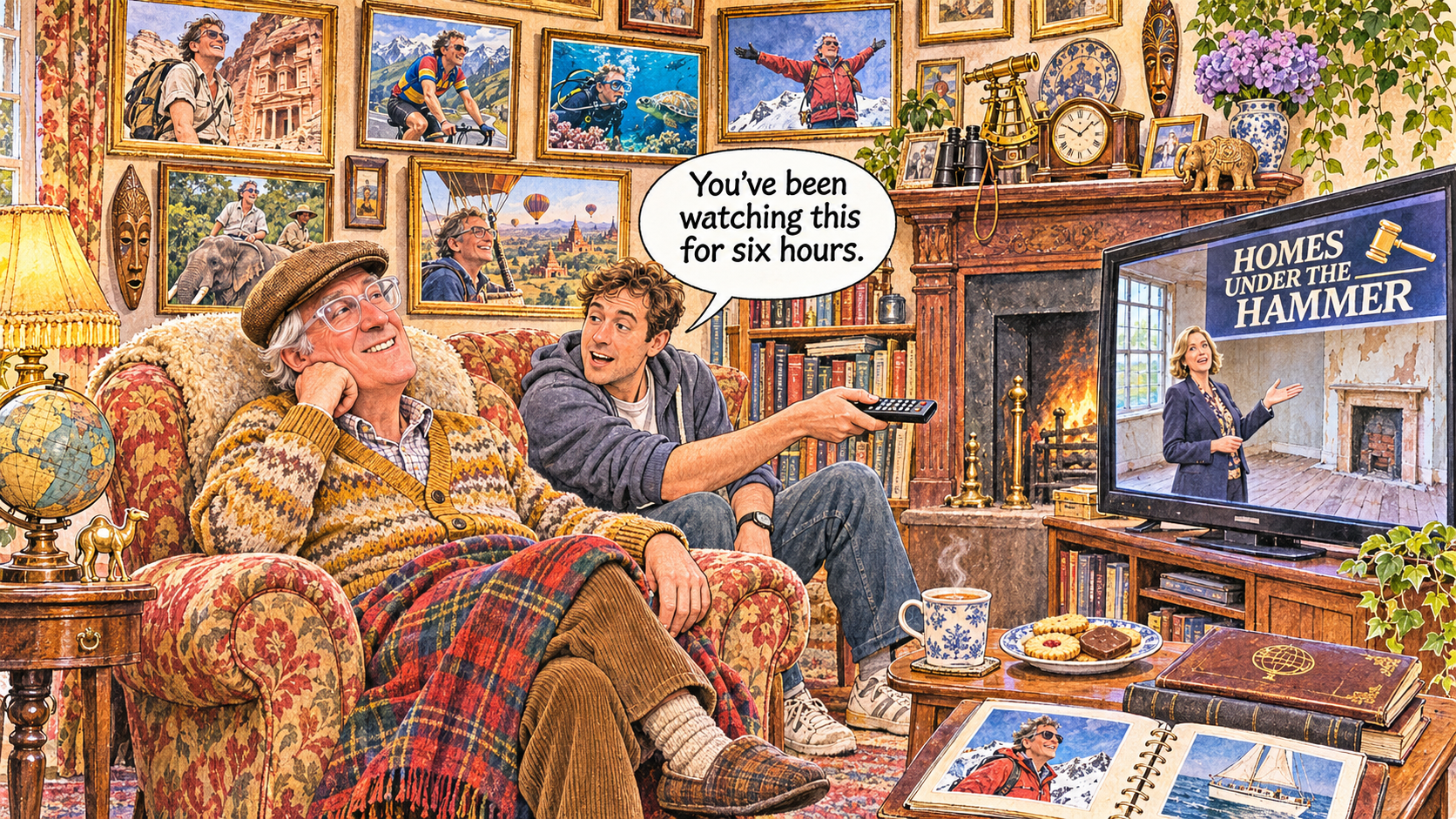
You will sit in a comfortable chair, surrounded by photographs, treasured possessions and possibly a tartan blanket, pleasantly recalling the rich tapestry of your life while somebody considerably younger changes the television channel because you’ve accidentally been watching Homes Under the Hammer for six hours.
This is the promise: your experiences will have been carefully curated, the wedding photograph, the naming of the firstborn, the graduation, the holiday in Tuscany, the ridiculous hat, the gown nobody has worn since 1978, the suit that hasn’t fitted since 1986 and didn’t look particularly good in 1986 either.
We keep all these things because one day, apparently, we shall need the memories. Nobody ever takes the photograph thinking: This will look lovely in the skip. Yet that is where most of it is going.
I have discovered this because eventually you become the person going through the possessions of the dead. You find the photographs of grandparents who survived world wars, unemployment, underemployment, bad teeth, worse governments and an astonishing quantity of brown furniture. Or perhaps they were wealthy and survived private education, ambitious employers, the requirement to know which fork to use and the lifelong terror that somebody might discover their grandfather was in trade. It doesn’t matter terribly much. Nobody escapes.
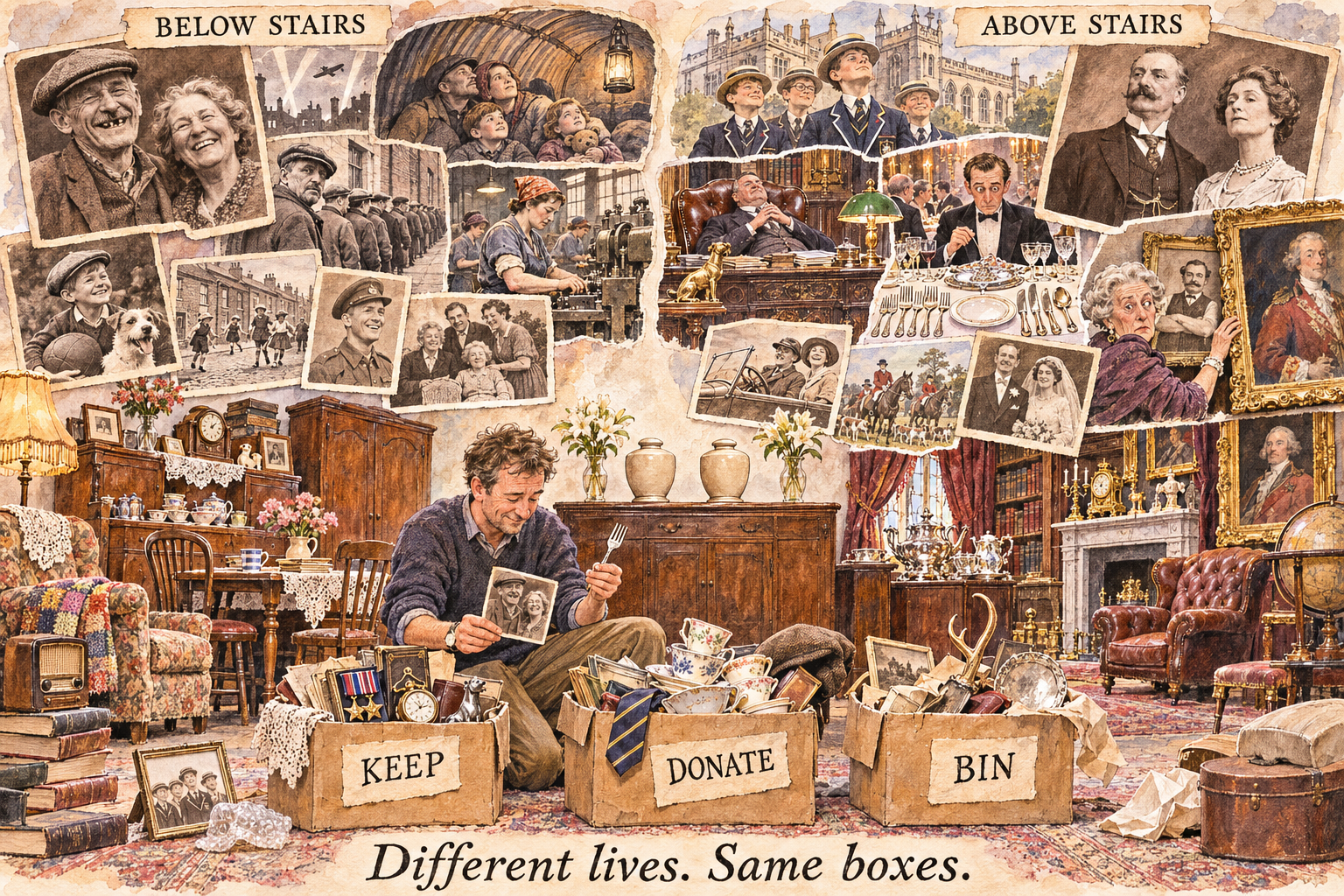
Every class has its humiliations. Every life has its hen-peckery, its courteous slight, its bullying, its disappointments, its moments when somebody with half your intelligence but twice your confidence informs you what you ought to be doing. And we accumulate the evidence: photographs, certificates, letters, jewellery, books, clothes, souvenirs, files. Proof that we were here. Proof that it mattered. Proof that, despite considerable evidence to the contrary, we knew what we were doing.
Perhaps that’s what memory really is: the appeal lodged against oblivion. Unfortunately, oblivion has an excellent legal team.
My wife was told she had three months to live. She managed this for nearly two years. I regarded this as evidence that the statistics were bollocks. This was not entirely irrational. Statistics are populations pretending to be individuals. They’re old data, different demographics, different treatments. It’s a bell curve, not Beachy Head. Somebody has to be at the far end of it, so why shouldn’t it be Helen?
Besides, new treatments were arriving. There were trials. There were possibilities. There was another doctor to telephone, another paper to read, another approach somebody somewhere was trying. And Helen was different. Of course she was different. She was my wife.
The great fuck-wittery of one-size-fits-all medicine is that everybody is an individual right up until somebody produces a Kaplan-Meier curve. Helen was a pharmacologist. She understood the curve rather better than I did. That didn’t stop me arguing with it. She, meanwhile, began taking inventory of her life. Had it been worth it? What had mattered? What could she still say? What could she leave behind that might communicate something of the extraordinary fact that she had existed at all?
She had always possessed an enormous capacity for wonder. Not necessarily at the things people were officially supposed to wonder at. We travelled, gardened, argued, worked, failed at things, succeeded accidentally at others, got diverted into countries and circumstances we’d never intended to enter. We made plans. We had a plan that went into our eighties. Then somebody altered the timetable.
Helen supported assisted dying. When Parliament was discussing it, she wanted to vote for it. She thought unbearable pain and mental disintegration were things a human being should be allowed to avoid. Intellectually, I could see the argument. Emotionally, I had a rather simpler political programme: No.
The point was to stay with me. One more day. One more conversation. One more treatment. One more possibility.
I didn’t want to sit with her looking through photographs of the time when we had been young. I wanted next week. Next month would do nicely. Then Christmas. After that we could renegotiate. Because I had begun to understand something I hadn’t understood when all those photographs were being taken. The photograph isn’t the valuable thing. The thing that happened while you were too busy taking the photograph was the valuable thing.
Towards the end, morphine began dismantling things. Memory didn’t become the comforting archive we had been promised. It became unstable. Fragments came loose. News stories got mixed into immediate reality. At one point Helen became terribly concerned about seventy-one children she believed she had to save. She was dying and still trying to save seventy-one children. I kept telling her she didn’t have to do anything. Just stay with me. She kept saying she didn’t know how to do this. Neither did I.
I was still waiting for a telephone call. There were options. There are always options until suddenly there aren’t. And then it ended. Just like that. Present tense became past tense.
Afterwards there were the clothes. This is one of death’s administrative cruelties. A human being disappears and leaves behind an astonishing amount of dry cleaning. The clothes are still there: shoes, dresses, coats. Things bought for occasions that now seem to have happened to somebody else.
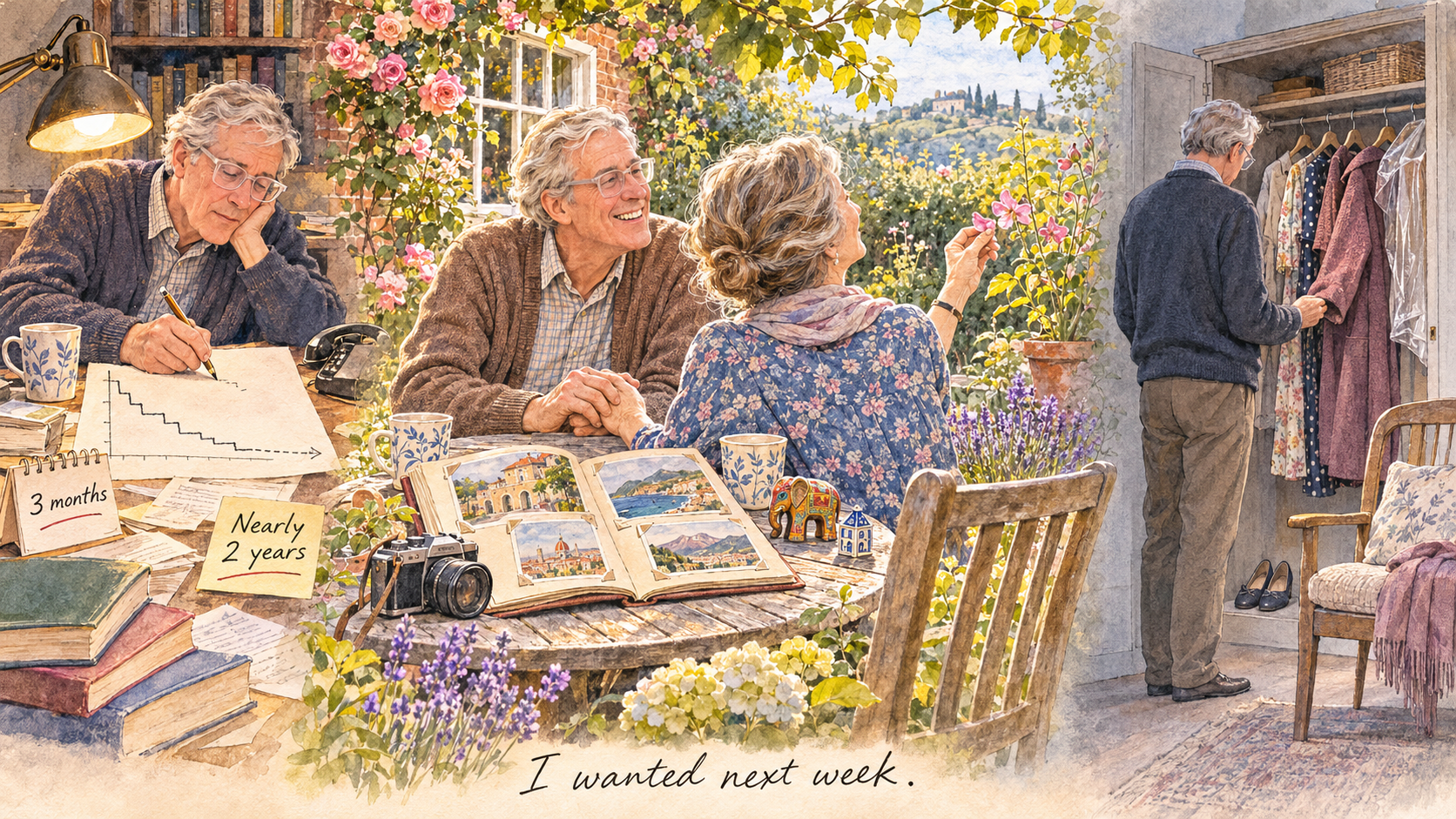
Sooner or later most of them will go into plastic bags and be taken to a charity shop, where some woman will unknowingly buy a fragment of Helen’s life for £8.50 and complain that the sleeves are a little short.
There is jewellery which surviving members of the family would like because it provides a memory of her. I understand that. Meanwhile I still can’t find her wedding ring.
There are books. Photograph albums. Computer files. Travel journals. Thousands upon thousands of photographs.
Near the end of one photo journal Helen wrote that this would probably be the last because she no longer had the energy to make another. I found that afterwards.
There ought to be a warning system on computers before opening things like that.
THIS FILE MAY CONTAIN YOUR PREVIOUS LIFE.
CONTINUE? Y/N
And what happens to all of it when I go? A museum? I rather like the museum option.
THE LAWRENCE AND HELEN GRAY COLLECTION
Visitors: 3.
One of them looking for the lavatory.
More probably everything will be put into cardboard boxes and deposited in the attic of a relative who doesn’t know most of the people in the photographs, isn’t terribly interested in the places and has confidently incorrect ideas about the period.
Eventually somebody will say: “Do we need to keep all this?”
And somebody else will say: “I don’t know.”
Which is how civilisation enters a skip.
The historian in me objects violently. Everything should be catalogued: Names. Dates. Context. Provenance.
This photograph was taken in Hong Kong in 1997. This one in Stockholm. This was the garden. This was the restaurant. This was the afternoon when something happened which seemed insignificant but turned out, years later, to be one of the moments I would most want back.
It should all be preserved for a thousand years.
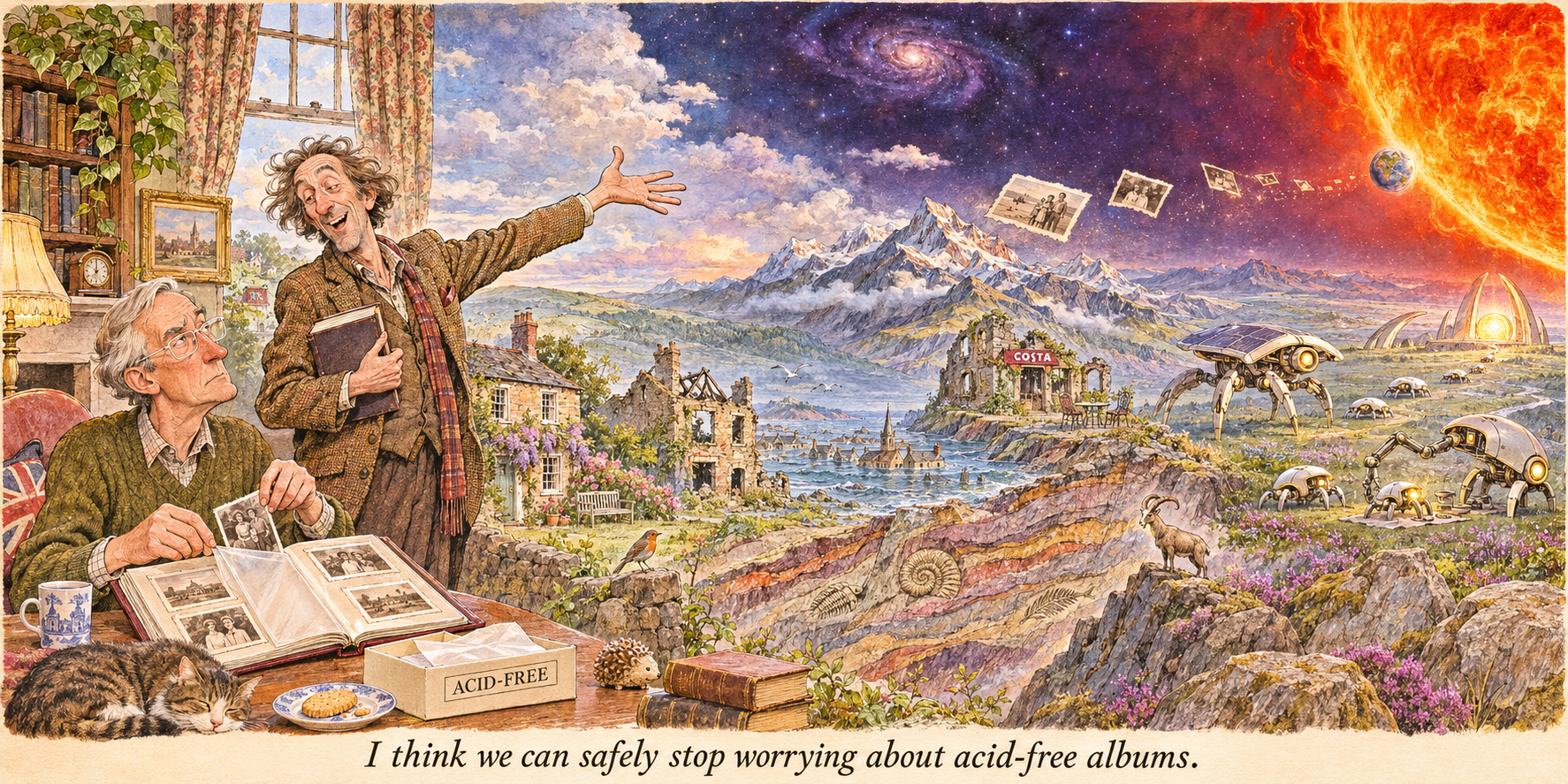
Then the philosopher wanders in and ruins everything. A thousand years? Why stop there? Eventually the house goes. The town goes. Britain goes. Humanity goes. Continents move. Seas cover things that were once mountains. Mountains appear where somebody once had a branch of Costa. Given enough time, archaeology itself becomes optimistic.
Perhaps whatever comes after us won’t care about history. Perhaps it won’t even be organic. Perhaps there will merely be machines drifting towards energy sources, repairing themselves, reproducing themselves, performing purposes whose origins have long since vanished.
Eventually the Sun expands. The Earth goes. The photographs definitely go.
I think we can safely stop worrying about acid-free albums.
And this ought to be depressing. Oddly, I don’t think it is. Because perhaps we’ve misunderstood what memories are for. They aren’t a replacement for living. They aren’t a pension scheme into which we deposit happy experiences so that at eighty-five we can withdraw them with interest.
Memory is unreliable anyway. It edits. It embellishes. It deletes. It puts people into rooms they were never in and gives you brilliant replies to arguments approximately thirty-seven years after they would have been useful. Memory is another story we tell ourselves: useful, beautiful, sometimes unbearable. But not life. Life only ever occurs now.
Helen and I spent decades growing each other. I hadn’t really understood that until she wasn’t there. We continually reinvented ourselves. We moved countries. Changed jobs. Started things. Abandoned things. Made plans. Failed magnificently to become the people we had intended to become and accidentally became some other people instead. We never quite settled.
In some respects, we remained teenagers. In others children. There was always the possibility that one day somebody might finally recognise us as adults and put us in charge of something. Fortunately, this seldom happened. We treated one another as adults. Or pretended to. What mattered was that we kept moving: looking, talking, arguing, laughing.
Occasionally staring at something and saying, essentially: “Bloody hell. Look at that.”
And perhaps that was the whole thing: not achievement, not posterity, not the archive. Not the hope that somebody in the twenty-ninth century will open Box 14B and be enormously impressed by our trip to Luoyang. Just the contact. The acknowledgement. The tiny instant in which one consciousness recognises another and both are briefly aware that this is happening. Everything else goes into the skip. The skip goes into landfill. The landfill becomes geology. The geology disappears into whatever incomprehensible business the universe is conducting without consulting us. Perhaps nothing remains. Perhaps everything repeats. Perhaps somewhere, given enough infinity, Helen and I are sitting in a restaurant again, complaining about the service and completely unaware that this is the most important moment in the universe. I hope so. But I don’t need it to be true. The moment happened. That was enough. We were there. And we laughed.
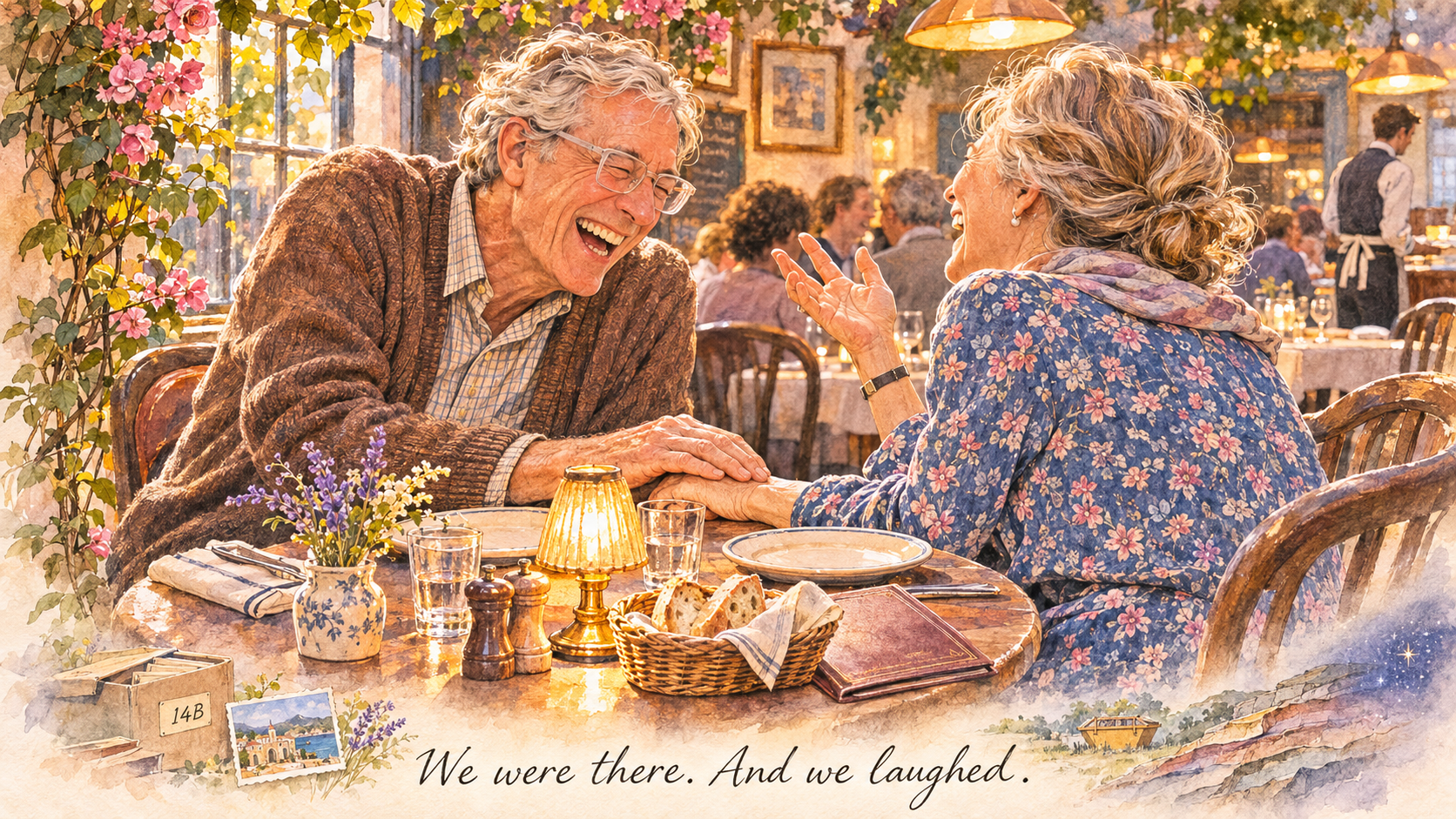
Of all the things consciousness can do with the astonishingly brief period during which the universe permits it to exist, laughter may be the best. Everything else is landfill.
BUY ME A BEER
SUBSCRIBE

Archives
WORDS OF OCCASIONAL WISDOM:THE BLOG
TRAVEL:
HISTORICAL ROAD TRIP AROUND MALAYSIA
Parts:
1, 2, 3, 4, 5, 6, 7, 8, 9, 10, 11, 12, 13, 14, 15, 16, 17, 18, 19, 20, 21, 22.
IN THE FOOTSTEPS OF ISABELLA BIRD
Parts:
1, 2, 3, 4, 5, 6, 7, 8, 9, 10, 11, 12, 13, 14, 15, 16, 17, 18, 19, 20, 21, 22.
BOOKS:
ADAMS FRANCHISE
COP SHOW HEAVEN
ODDS AND SODS
LIMINAL BRITAIN
FILMS:
LUST AND FOUND
ZOMBIE RADIO
DOCUMENTARIES:
THE HIDDEN HISTORY OF JOHOR BAHRU
THE HIDDEN HISTORY OF JOHOR LAMA
OTHER PAGES:
FABULOUS SHORT STORIES
SCREENWRITING TIPS
TRAVELING WITHOUT A PURPOSE
Johor (1)
philosophy (1)
#bonkers #animation #stopaction #whimsy (1)
#time #science #philosophy #physics #relativity (1)
After covid (1)
Age (1)
ageing (1)
Article on British and Malay cultures. (1)
Autobiography (1)
Baby boomers (1)
birthday (1)
bonkers (1)
british (1)
British Society (1)
Cigars (1)
comedy (1)
Cool (1)
corvid19 (1)
covid19 (3)
Demonstrations (1)
Documentaries (2)
Endlockdown (1)
Endoftheworld (2)
Endsocialdistancing (1)
Epidemic (2)
Extradition Bill (1)
fiction (1)
fifty year old music (1)
Hansard (1)
History (4)
history (1)
Hong Kong (1)
humour (1)
Jeeves (1)
Lifestyle (5)
Literature (2)
Lockdown (2)
Malaysia (1)
Music (1)
P.G.Wodehouse (1)
Parliament (1)
Philosophy (2)
Plague (2)
Politics (3)
reminiscence (1)
smoking (1)
Social Distancing (3)
The Future (2)
The meaninglessness of it all (1)
The Plague (2)
The virus (1)
Travel (4)
travel (1)
Umbrella Revolution (1)
vice (1)
video (1)
virus (1)
vLOG! (1)
Wisdom (1)
Wooster (1)
Writing life (1)