
There are several charitable organisations run by members of the expat community in Johor Bahru, and the official Corporate Social Responsibility program ensures that those in employment spend some time/money to help the less fortunate in our community. But, what can you do as an individual? I would like to suggest that your first contact point might be the Community Services Committee of the Malaysian Red Crescent (MRC), and here is why.
When disaster strikes in Malaysia, the MRC steps up to respond as evidenced by their recent work to help the flood victims in Johor (see ‘After the floods' and 'After even more floods!!!’). At this time, expats may want to help but are uncertain who to approach and what best to do. At the instigation of her son, Florence approached Lekha Nandey (National Committee for Community Services, MRC) offering to help the flood victims, but that crisis has now subsided. So, Lekha invited Florence and her son to come and learn about the sort of things which require help on a more regular basis (see photo above). In 2019, I followed Lekha Nandey on some of her activities and have generated a webpage to collate these reports, so you can keep up to date with her activities there. Lekha will tell you that she is only one of a dedicated group of people, but as she has been my contact point throughout, I cannot help but mention her in this report.
In many ways, the Community Services Committee of the MRC acts as a facilitator and coordinator of relief aid. And, as Malaysia is a multiracial country, the MRC tries hard to make sure that no community group is left out. For example, during the Hari Raya festivities after Ramadan, the MRC organised the distribution of food packages to the immigrant Muslim community (see ‘Hari Raya at Masjid India’). And, during the Hindu celebrations of Deepavali, they distributed food to local workers (see ’Deepavali and the Malaysian Red Crescent’). Similar activities occur during Chinese New Year for the Chinese Community, and during Christmas for the Christian community. Importantly though, none of these activities are exclusive to any racial/religious group.
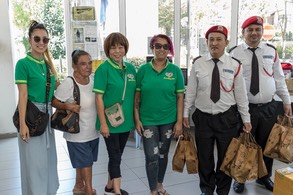
Similar charitable activities are organised by the expat Poonam Singh and her Glocal Helping Hands group, as shown here during Deepavali. Good coordination between all charities is required to make sure that as many people are helped as possible, and there is no duplication of effort.
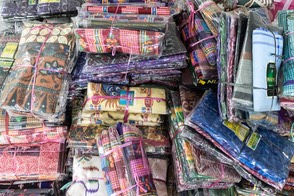
Providing such services to the community on the regular basis requires funding, so if you would like to help, making a donation to the MRC is often the simplest starting point for many people. But what if there is a national disaster such as the recent flooding? Once again, a donation of money is often the most efficient thing to do. Why? Because if everyone donates old clothes, they usually need to be first washed, sorted, and then distributed; all time consuming and inefficient. Much simpler to send out one-size-fits-all sarongs and teeshirts.

And, if people donate food it is often all the same stuff when people may need help with soap, shampoo, towels, daipers, sanitary towels, and other more practical items. By planning in advance, the Community Services Committee of the MRC can stock up in advance of the expected disasters (i.e., the annual floods) and can maintain these stocks in distribution centres around the country.
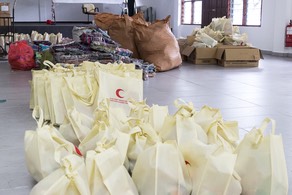
Then when needed, the required assortment of goods can be put into bags for easy distribution to those in need. The outreach of the MRC also means that they quickly know what is most needed and where. Such emergency provision capabilities require donations outside of the emergency event to make a rapid response practical.
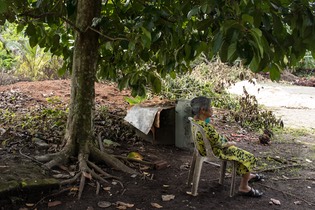
There are many people in need in Malaysia who often fly under the radar. But when word of such people comes to the attention of the MRC, Lekha will try and arrange something to help. Take for example this elderly lady in Pontian (see ‘Pontian with the Malaysian Red Crescent’) who needed help with her accommodation. Some MRC volunteers and the Amal Team Johor (an NGO that helps the needy) were organised to help repair the house and put in a better concrete floor. If you have such practical skills, then you could consider donating your time to help with similar projects.
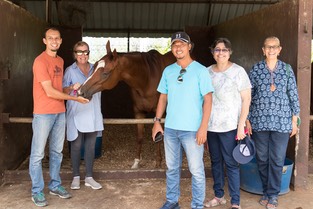
Or perhaps you have a more specialist skill such as horse riding? When Sukhjit Kaur of the Cerebral Palsy Association of Johor was looking to re-establish a Riding for the Disabled activity, then horse women Diane Barrans stepped in to help. Volunteers are always needed here to help walk the horses while the clients are riding around a paddock.
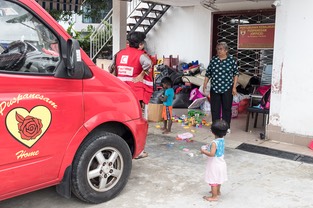
So, back to Florence and her son and thoughts on how they could help the needy here in Johor Bahru. We visited the Puspanesam Home in Kampung Johor Bahru. This is an orphanage for 16 children and an old peoples’ home for a select few. They are relatively well-funded and sometimes receive goods which they cannot use or do not need. Under such circumstances, they might contact the MRC to find out where best to redistribute these goods.
These are just some examples of ways that the expat community can become involved in charitable work as individuals. I am not in a position to list all potential charities in Johor, so am focussing here on activities with which I have had personal experience. If you have time to donate but do not know what best to do, please contact Lekha Nandey for advice. And, if you have money to donate to the Community Services Committee of the MRC, again please contact Lekha Nandey for payment instructions. Her phone number is 019 755 5600. Just say Helen sent you!
Click here for my webpage on the Malaysian Red Crescent.
Click here to return to Helen Gray’s homepage.