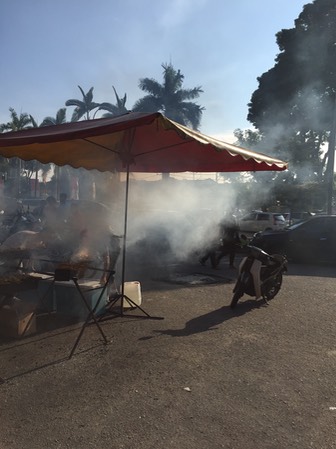
Friday 24th April marks the first day of the fasting month of Ramadan, a time spent on self-reflection and a time spent with family and friends. For non-Muslims, we more likely associate Ramadan with food for this is the time of the Ramadan Bazaars; street-side food stalls selling deliciousness. But for everyone in Malaysia, this month will be like none gone before. The first week of Ramadan represents the sixth week of the lockdown here in Malaysia because of the coronovirus pandemic sweeping the world. So, all public gatherings are prohibited, mosques are closed and Ramadan bazaars are banned.
For a foreigner such as myself, it is the period of Ramadan which most clearly tells me I am living in a foreign country with a unique culture. And it is the unique culture of a nation which seems to have a huge impact on how it handles the current COVID-19 outbreak. Let’s start by comparing the two countries most relevant to me personally, Malaysia and the UK. When you look at the following figures, bear in mind that the population of the UK is approximately double that of Malaysia:
Malaysia has 5482 confirmed cases of COVID-19 and 92 deaths
UK has 133,495 confirmed cases of COVID-19 and 18,100 deaths,
So, if Malaysia had the same population as the UK, and behaved the same as the UK, you would expect 66,747 cases of COVID-19 and 9,050 deaths. So, why is our death count 100-times lower?
You might instinctively say that cases are underestimated in Malaysia as we aren't testing people, but you’d be wrong. People are being tested and contact tracing is active. So, what else is Malaysia doing which has proven so effective?
1. We are lucky to have a smart guy directing operations, and this is the Director General of Health, Dato Dr. Noor Hisham Abdullah. At the start, politicians were saying things like "drinking hot water will help kill the virus”, and other such unscientific nonsense. In countries where scientists are not given a voice in this matter, the people suffer.
2. Although the Malaysian Government was a little distracted by a political coup at the beginning of the outbreak, when it got going it was firm and its message was clear. On the 18th April it gave us two day’s warning of the Movement Control Order (MCO) which can be summarized as “Stay at Home”. This was initially set for two weeks, but is constantly under review so will continue for at least eight weeks.
3. Borders are closed. Non-Malaysians are allowed to leave Malaysia to return home, but Malaysians cannot leave. Malaysians can enter the country but non-Malaysians cannot. This latter point could have been a problem for people like myself who have long stay visas but whom the Government views as foreigners. There are many foreigners who have made Malaysia their home and have no home elsewhere (e.g., married to Malaysians or holders of the Malaysia My Second Home visa) but are not allowed back in during the MCO period.
4. Currently, any Malaysian returning home gets imediately tested for the coronavirus and is quarantined in a Government facility for 14 days before being allowed to return to their family home.
5. Currently, anyone who suspects they are infected is directed to a public hospital set up for that purpose. No one goes to private hospitals if they have the virus.
6. The plight of the homeless was recognised early on with many NGOs stepping up to help to provide food. To better control the situation, the Government has housed the homeless of Johor Bahru in a local recreational facility so their health status can be monitored and they can be kept well fed.
7. The Health Ministry sends texts to our mobile phones with updates and reminders and encouraging notes. This texts come in Malay but Google Translate works well under these circumstances.
8. The Government has produced an App ‘MySejahtera’ which runs on all phone operating systems. We can enter information on our own health status so early signs of a local outbreak can be detected, we can find out if there are any cases reported locally, we can find out our nearest hospital dealing with infected patients, and at last we have some Government information available in English as well as in Malay.
What does the MCO involve? Basically, no one should be out of home unless they have an essential job, they need medical assistance, or have to shop for food or medicines. You cannot go out for a walk or to exercise. Only one person is allowed in a private vehicle and that should be the head of the household. And, no one can travel more than 10 km from home without Police permission. There are road blocks controlled by the Police and with armed Army personnel and a fine of RM1,000 per person to deter unnecessary travel. Even the road blocks are smartly organised so that essential services do not get trapped in the queues of private vehicles.
In the State of Johor where I live, the compliance rate for the MCO is an astonishing 99%. My Chinese friends told me this was because Malaysians were compliant, and I thought WHAT??? You see the one thing you quickly learn when living in Malaysia is that Malaysians do not follow regulations, and that regulations are not enforced. The most obvious example is anything to do with their cars. They park anywhere and think nothing of double or even triple parking. Double yellow lines are for decoration. The use of car indicators is an affectation. No one pays parking fines until the time comes when you can get a discount.
So the fact that so many Malaysians are following the Government’s instruction to Stay Home is extraordinary, but contributes considerably to the low rate of infection we are experiencing. So why was the UK Government so reluctant to bring in similar movement restrictions? Afterall, UK citizens are law-abiding, at least when it comes to driving, parking, and paying fines.
My conclusion is that if you allow people to ignore the ‘little personal’ things as in Malaysia, they will do what you want when saving the country is more important and they believe the Government knows better than themselves. But in countries like the UK where people generally follow the rules, they have a superiority complex and feel they know what’s best for themselves and do not need a Government to tell them what to do. So, if they want to continue meeting friends in the park, they will do so. And no UK Government could dream of bringing in the army to help in such times. Of course, these are my own personal observations which may need revising as time goes on, but I think the way the different countries have responded to the coronavirus outbreak tells us alot about its people and their relationship with their Government.
Click here to return to Travels in Malaysia 2020.
Click here to return to Helen Gray’s homepage.