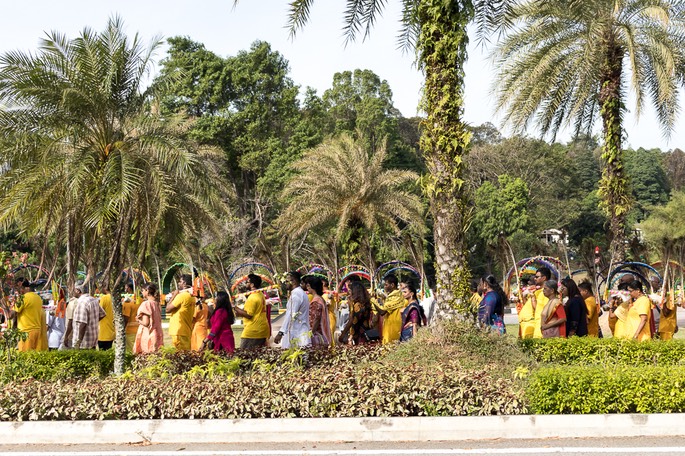
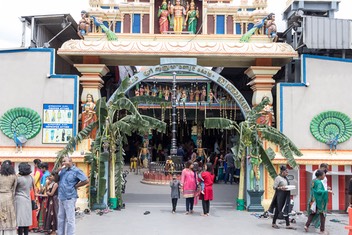
I first came across the Thaipusam festival in Feb. 2017, where I came across the procession at its starting point in Taman Merdeka before processing along Jalan Kolam Ayer to the Sri Subramanian Temple in Johor Bahru. Then in Feb. 2018, I attended the event in the larger Arulmigu Rajamariamman Devasthanam Temple in central Johor Bahru.
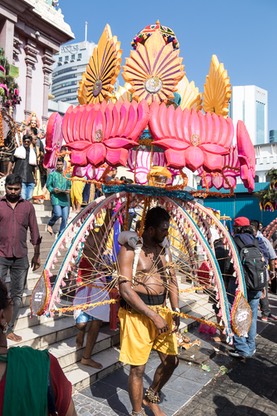
Thaipusam is a time for Tamil Hindus to honour Lord Murgan, the Hindu god of war and a son of Shiva. While the rituals are the same at both temples, the scale of the event is quite different. At the Arulmigu Rajamariamman Devasthanam Temple you will see more people with their cheeks pierced with skewers and men carrying huge colourful objects with spears piercing their torso (you can see more images of this event by clicking here).
This year I had the opportunity to experience another aspect of Thaisupam which involves food, because the Sri Subramanian Temple prepares food for 5,000 every year. These worshippers clearly won’t be regular visitors to this temple, but on the morning of Thaipusam they will visit several temples in the area and time their activities to arrive at the Sri Subramanian Temple in time for lunch, as this temple has the reputation of serving the best food in Johor Bahru! If you have had any experience of the Hindu and Sikh temples here, you will know that they have a tradition of giving food to anyone, indeed The Sikh Temple in central Johor Bahru has a huge kitchen which operates daily. All this is part of the concept of ‘Seva’ or the Art of Serving from your Heart. Seva is a Sanskrit word meaning selfless service; service to others with no expectation of outcome. I was attending Thaipusam with my (Hindu) friend Lekha Nandey from the Malaysian Red Crescent, and every time I have accompanied her and her Malaysian colleagues around Johor (for more details click here) I see this concept of Seva in action.
THE DAY BEFORE THAIPUSAM
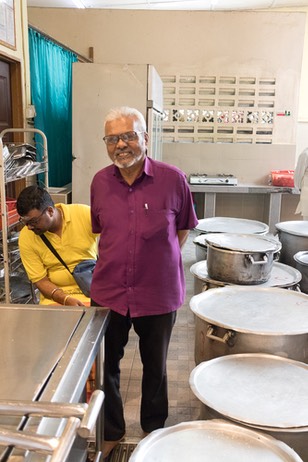
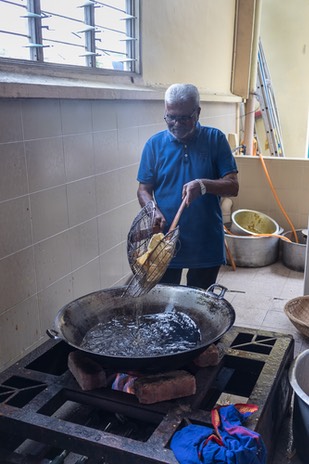
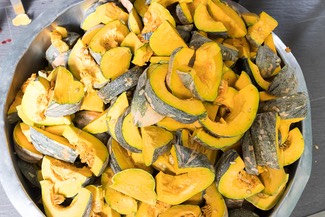
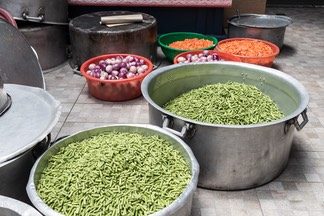
Feeding 5,000 people takes some organising, and food preparation was well underway when I arrived at the Sri Subramanian Temple on Friday (7th Feb.) lunchtime. Mr. Aponi K.C. Nair (shown below) is the reason everyone comes here for the food. He is a very calm man who was busy frying hundreds of popadoms when I arrived. On Saturday the proud chef was standing by the huge vats of vegetarian delights, waiting for the mass of people to arrive.
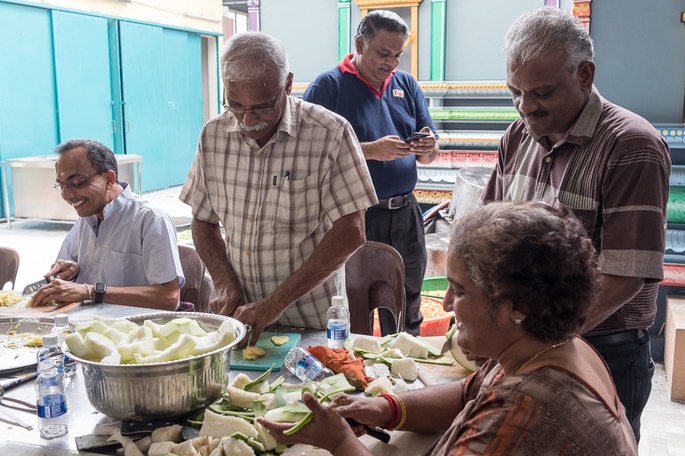
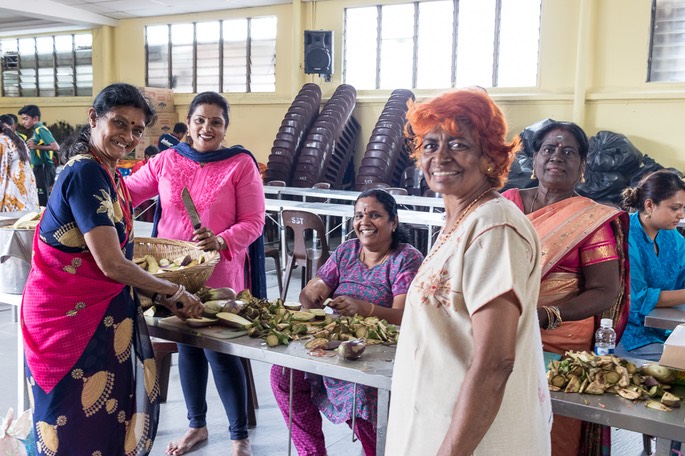
What struck me about the people preparing all the vegetables were the smiles on their faces. This was a joyous communal activity where everyone had a role to play in preparing the feast to come.
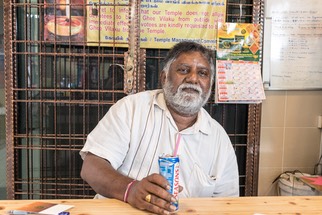
After eating a delicious vegetarian lunch, I had a chat with Mr. M. Surendran who is the Treasurer and member of the Temple Committee. There is still a lot about this event that I do not fully understand, in part because words have different meanings to different cultures. Mr. Surendran assured me that if devotees fasted as instructed prior to Thaipusam, they would feel no pain from the skewers and there would be no bleeding when the skewers were removed. To me, fasting means no solid food just water, but Hindus have to fast for several weeks before Thaipusam. For them the word fasting means only fruits and milk.
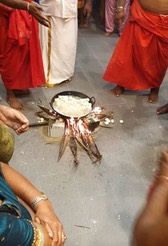
Mr. Surendran suggested that I visit the temple that evening for a very special event, but sadly I was not free to do so. So I have borrowed this photo from a friend. The devotees grind rice to prepare rice balls which are then deep fried in boiling oil. The devotees are expected to pick out a rice ball from the boiling oil, and carry it in their hands to the altar, some distance away. I am reliably informed that there is no damage to the hands. Now this ritual does not take place in all Hindu temples, indeed Thaipusam is not celebrated by all Hindus. The practice comes from the south of India and we still see it today in Malaysia because southern India is where many Indian came from to work in the rubber plantations many years ago. The practice of picking out rice balls from boiling oil is mostly associated with Tamils from Kerala state, which is why this only occurs in temples founded by Tamils from Kerala.
THE THAIPUSAM PROCESSION
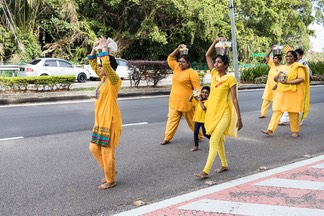
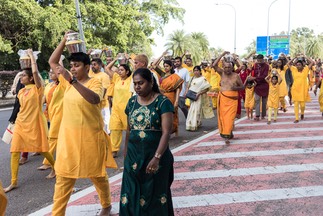
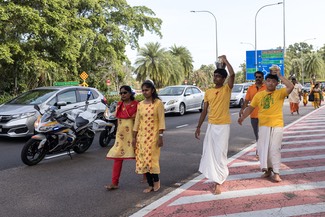
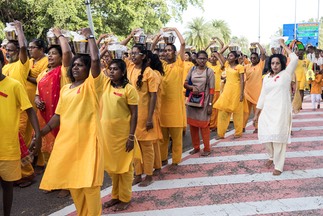
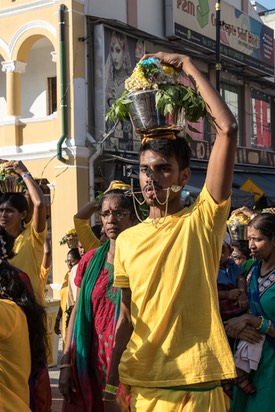
The procession on Thaipusam day was led by a noisy band, and consisted of devotees carrying kavadi or milk pots, chanting as they walked barefooted to the temple. In the past, devotees would have worn white clothes as a sign of purity, but nowadays they main colour is yellow. Apparently, in the past they would have had saffron and turmeric water thrown over them as an antiseptic, to prevent any infection, so of course their white clothes would have become yellow. Today they simply wear yellow clothes, but the use of saffron and turmeric water inside the temple for cleansing still occurs.
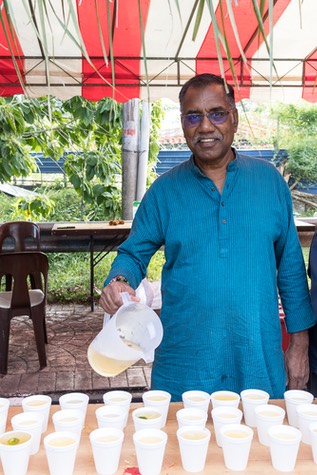
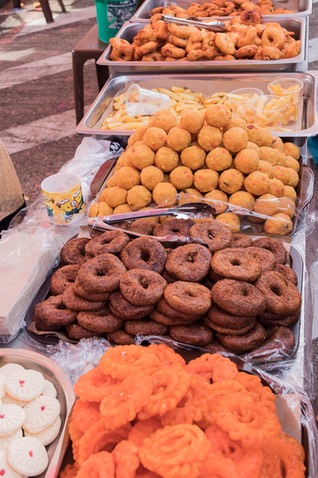
Just outside the temple were stalls giving out drinks and snacks, but the devotees would have to wait as they still had to complete their tasks for the day.
The procession then headed into the temple….
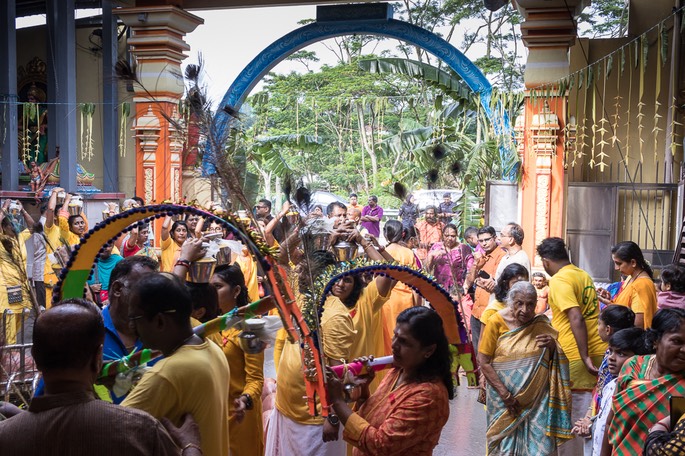
The people carrying the kavadi headed into the central part of the temple, then the kavadi were removed and passed along a chain of guys to be stored somewhere safe.
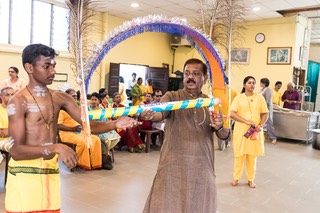
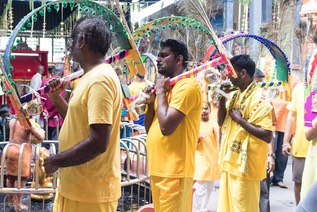
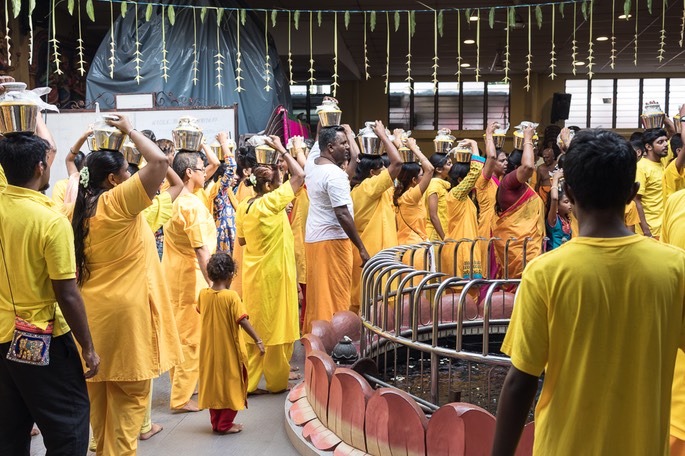
The milk pots were carried around the central area of the temple, and the milk was poured over the god of the temple.
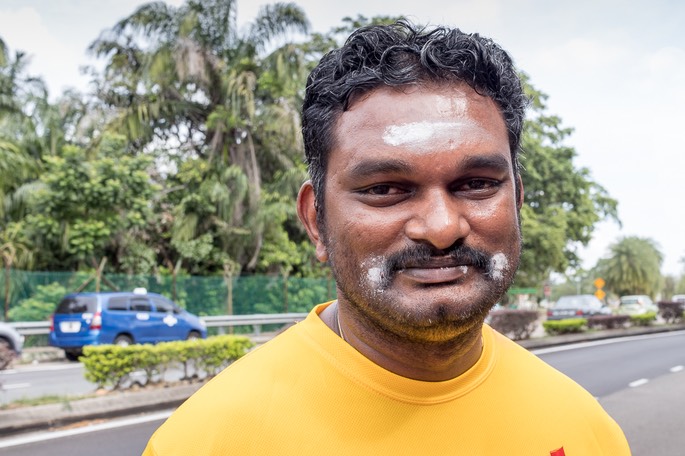
While we were waiting for the food to appear, we wandered outside to sample the salty yogurt drink and the more refreshing lime water drink. Here I met one of the devotees and he was happy to let me take a photo to show how everything was OK after removal of the skewers which had pierced his cheeks.
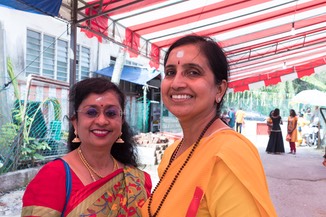
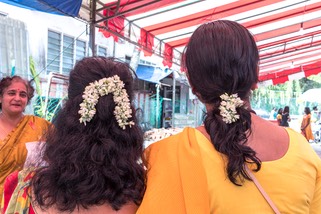
Many of the ladies had flowers in their hair today, so here are two lovely ladies as examples…..
THE FEEDING OF THE FIVE THOUSAND
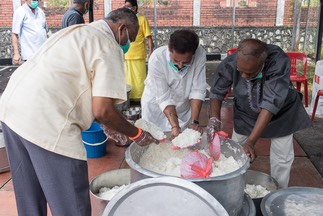
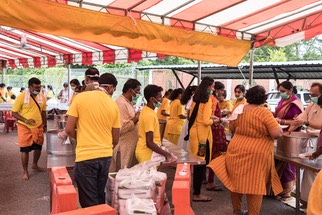
Around 11 am, people were getting everything ready for serving the food. Metal buckets were laid out in order of size, the largest to contain the rice and the smallest for the sambal.
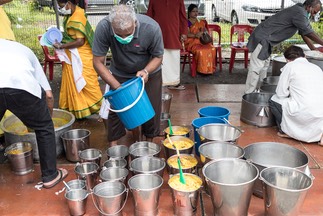
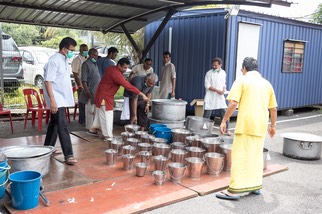
It was hard working dragging the heavy pots of cooked rice from the kitchen to the serving area, and then dispensing the rice into smaller pots for the servers.
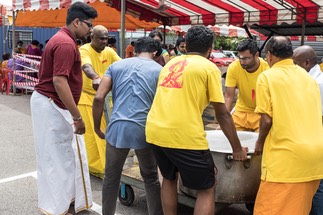
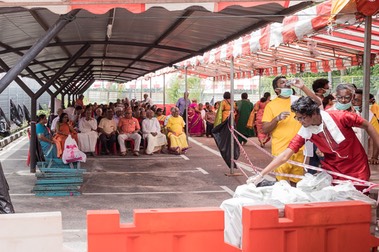

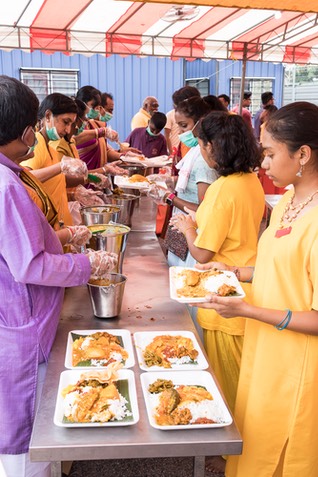
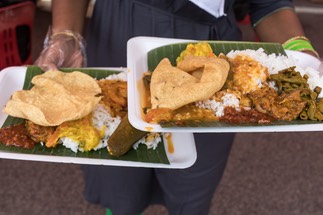
The more senior members of the temple waited patiently for the food to be served to them, and then the devotees lined up to receive their meal and a drink of water. It was indeed a very tasty meal!
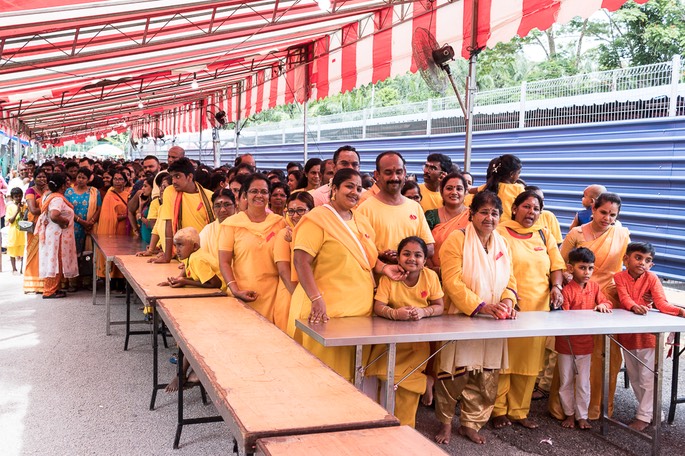
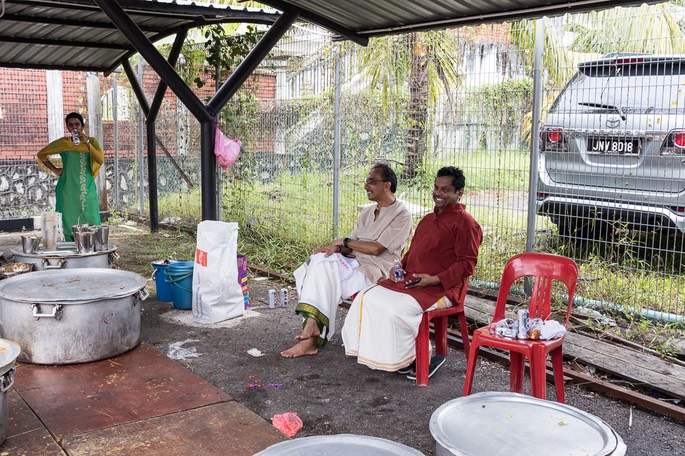
Finally, all that hard work came to an end and you can see the relief on the faces of the guys in the photo below. I suspect they did not feed 5,000 today because the coronavirus spreading around this region has kept people away. For the devotees, they still had some more rituals to undergo the next day to complete the process, but for everyone else it was time to go home knowing they had done their part in celebrating Thaipusam and honouring Lord Murgan.
And here is a short video highlighting today’s activities.
Click here to return to Travels in Malaysia 2020.
Click here to return to Helen Gray’s homepage.