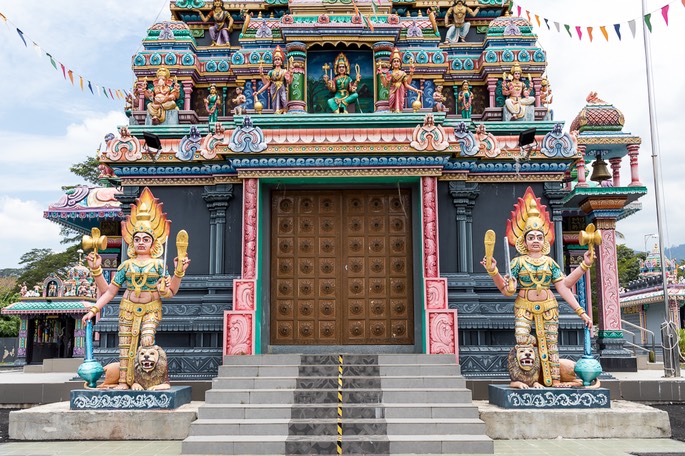
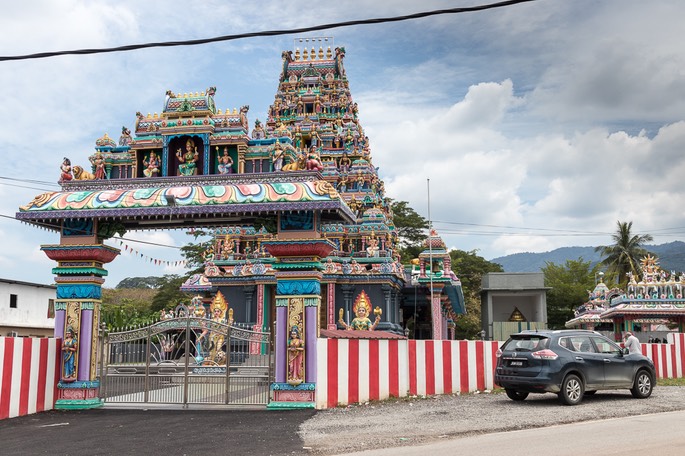
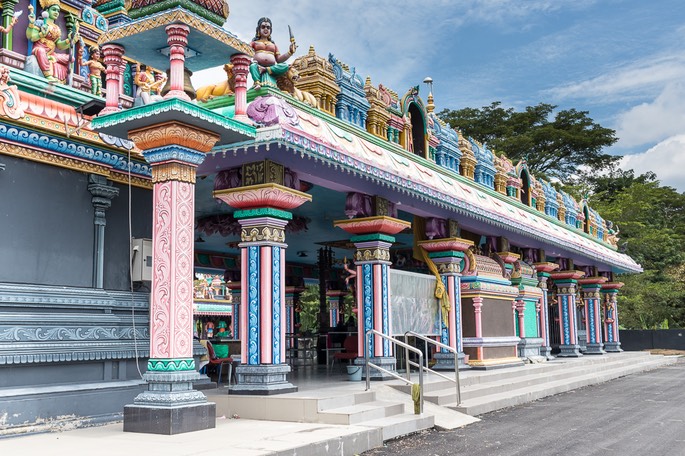
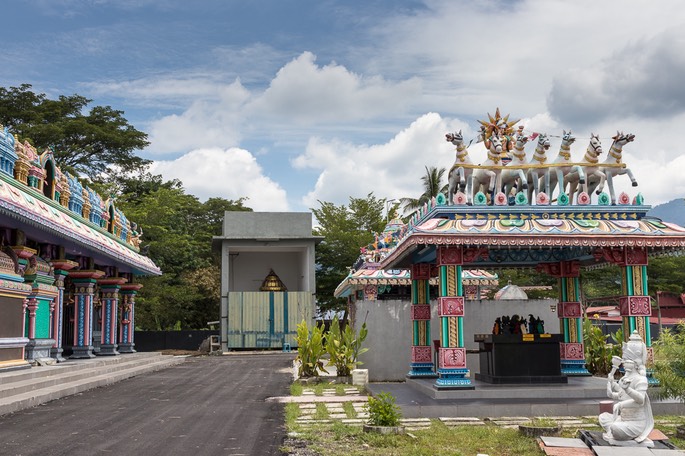
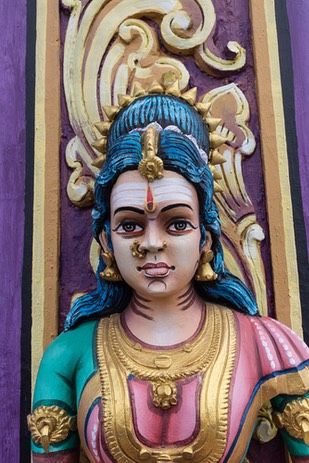
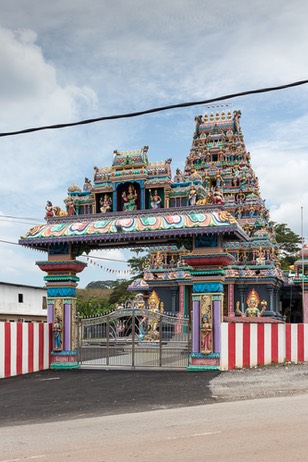
Somewhere along Route 1 from Bujang Valley to Alor Setar, we saw the most colourful Hindu Temple on the left of the road and pulled over for a better view. I believe we were near Guar Chempedak, but I cannot find a temple location on Google Maps. The gates at the front were locked, but a couple of guys on motorbikes pulled over and told us that there was an entrance at the back. That too was also closed, presumably because of the COVID-19 restrictions, so we took photos through the railings (for more photos, see below).
According to the 2010 census, 6.7% of the population of Kedah are Hindu, and this temple clearly says “We are still here!” The reason I say this is because so many of the Indians I have met in Johor Bahru tell me of their concerns that their history in Malaysia is being wiped out by the government. Even some of the Chinese community, which make up 20.6% of the population in 2019, have similar fears. So, let’s see what I have learnt from the road trip.
When you explore the archeological sites in Kedah (Bujang Valley Archeological Site on Day 8 and Sungai Batu Archeological Site on Day 13), there is no escaping the fact that the Indian culture of Hindu-Buddhism took hold in Malaya from the 2nd century A.D. This culture would have come with the sailors from South India who would have settled in Kedah during its dominance as a maritime trading centre between India and Arabia in the west and China in the east. Gold and tin, amoungst other local products, were also traded here. As early as 110 A.D., the Bujang Valley was part of a Hindu-Buddhist kingdom, and by the 7th and 8th centuries this area was part of the extensive Srivajayan Empire originating from Palembang, Sumatra. Its riches were later fought over by the Siamese and the Achenese, and in 1136 the ruler Phra Ong Mawangsa converted to Islam and adopted the name Sultan Mudzafar Shah. Kedah was taken over by the Melakan Sultanate in the 15th century, then the Portuguese in the 17th century, then Acheh, then Siam again. It does not become part of British Malaya until the Anglo-Siamese Treaty of 1909.
None of this history is hidden from the public, so it is clear that there was a significant Indian presence in Kedah before the rise of the Melakan Sultanate in the 15th century. But there were also Chinese, indigenous Malays (the Orang Asli, etc) and Malays (often from Indonesia) living here too. It would be hard to think otherwise given the historically significant worldwide trading location of Kedah in the time of sail boats. Cultures come and go over the centuries, but never truly disappear. But when a 1200-year-old Candi (Site 11) was demolished by a land developer in December 2013, it shows how fragile that historical presence can be if unprotected.
We visited many state museums on this road trip, and the role of the Chinese, Indian, and Malay communities in Malaysia is always presented to the public; Indian history is not hidden. But I have yet to meet an Indian who can trace their roots back more than three generations in Malaysia. For the majority of Indians in Malaysia today came here as the result of the British colonisation; they were encouraged to migrate here to work on the rubber plantations, for the military, and for the police force. When the British presence here was due to the East India Company, Indian prisoners were shipped to the Straits Settlements, e.g., Penang, to provide free labour for the company.
Currently, the majority of Indians in Malaysia, especially in the west coast of West Malaysia, came originally from South India. Just look at the many Indian restaurants in Johor Bahru where the majority will be serving South Indian foods. So many of these Indians will be Hindu Tamils. Now unless an Indian is wearing a turban and one can identify him as a Sikh, most people will have difficulty distinguishing an Indian’s religion from a quick look. This was made evidently clear to me when we went in search of the Cherok Tokun Relics (just outside of Taiping) on Day 13. This relic marks the southernmost point of the ancient Hindu-Buddhist influence, but it is housed in the grounds of a Catholic church. When we went up to the church to ask for directions, the gentlemen church wardens were Indian. Their families would likely also have come from South India/Sri Lanka. I mention this to highlight the difficulty of identifying someone’s cultural heritage, especially in Malaysia which has been multicultural for centuries.
So, when my Indian friends talk about having their history ignored, I saw no evidence of this on this trip. It was something that Lawrence and I were on the look out for, and we did not see it. I should add though that many museums did not present a coherant story to explain their contents on display, so you would have to work hard to figure out the ancient history of the country. The more recent role of the Indian community was more noticeable in museums, especially in the National Museum in Kuala Lumpur where the cooperation between the Malay, Chinese, and Indian communities was presented as essential in obtaining independence from the British. But when my friends say they are being written out of Malaysian school textbooks, well that’s another matter.
So let’s return to the colourful Hindu Temple that sparked this conversation above….
Click here to return to Day 8 - Jeria Hill to Alor Setar, via Bujang Valley.
Click here to return to The Great Malaysian Road Trip.
Click here to return to Travels in Malaysia 2020.
Click here to return to Helen Gray’s homepage.