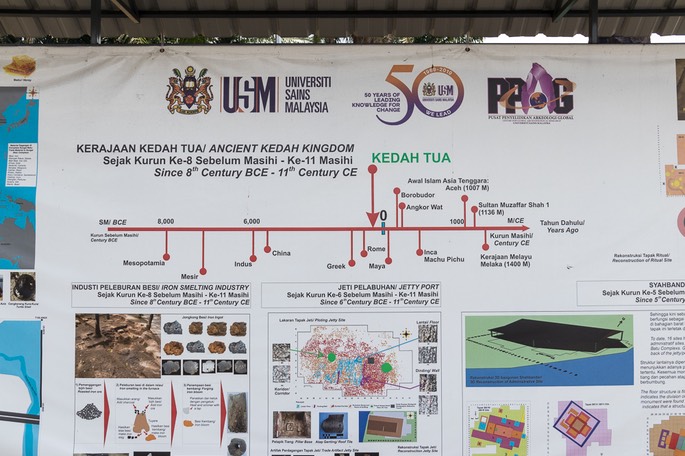
It was time to leave Alor Setar today and start on our journey south. Our first destination was the Sungai Batu Archeological Site, which was an hour’s drive away and back near to the Bujang Valley which we had visited on Day 8. Unlike the Bujang Valley Archeological Site, at Sungai Batu they are actively excavating the site, and it is HUGE! At the entrance to the site is this display panel, and the most important take-home message here is that this site is 500 years older than the more famous ancient sites of Borobudur and Angkor Wat, dating back to the 5th century B.C.
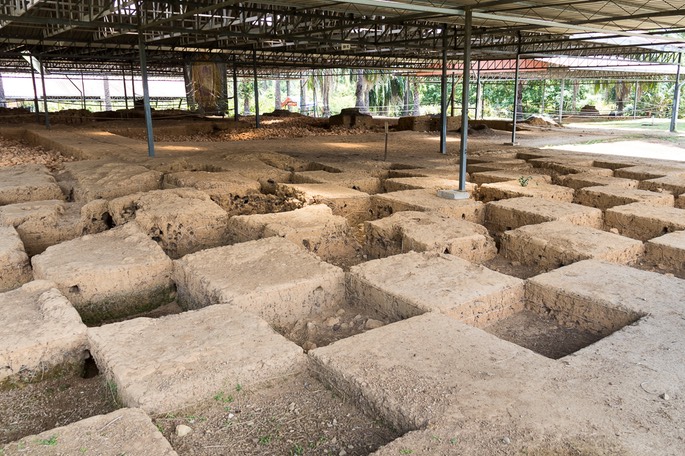
It is quite difficult to figure out what you are looking at, other than piles of old broken bricks and stumps of palm trees. And this emphasises how important the Bujang Valley Archeological Site is because there they have relocated and reconstructed the ancient temple remains, so the visitor has a better understanding of what they are looking at. If we had visited these two sites in the reverse order, it would all have made much less sense.


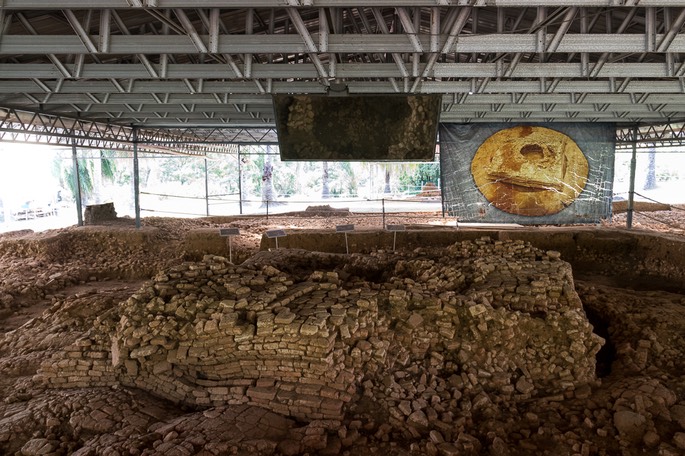
This photo below shows the best preserved structure candi on the site, possibly a candi but uncertain, and the overhead mirror allows a better view of its structure from the top.
From this map, you may get some idea of the scale of this site. The excavation sites are scattered on both sides of the main road and visitor access is on the northern side.

There are over 50 site excavations here and evidence of jetties or wharves, and kilns. It is believed that this was an iron smelting site from 1020 AD, with iron being transported back to India. According to penang-traveltips.com, ancient shipwrecks were discovered here in 2015, indicating the importance of this river system to international trade thousands of years ago, well before the present Kedah Sultanate existed.
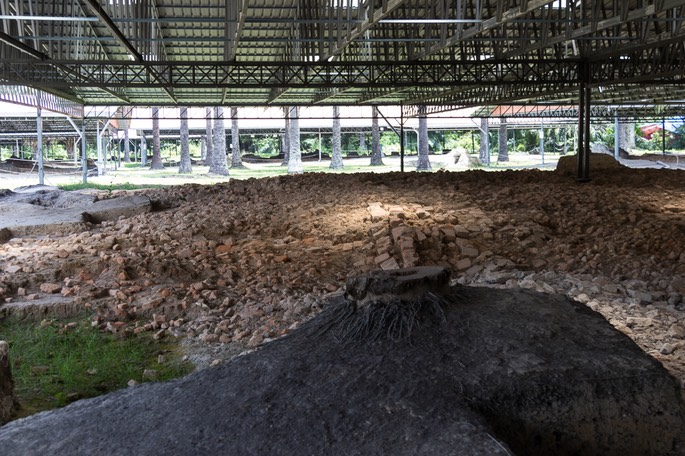
One of the main difficulties with excavating this site is that it is now an oil palm plantation, as you can see from all the tree stumps in the excavations and the tree trunks in the background of the photo below. It makes one wonder how much of Malaysia’s history is still buried under industrial-scale plantations.


We did have to register with the guard to enter this site, but then we were free to wander around ourselves. There is no one here to show you around or to answer any questions. We found evidence of work in progress, but no-one working at the moment. It is clearly a massive undertaking to research an area such as this.


Our next destination today was a further hour’s drive south to the Cherok Tokun Relics in Penang. These are ancient inscriptions on a rock in Bukit Mertajam and is the only ancient megalith in Penang. To find this rock, you need to stop in the complex of the Sanctuary of St. Anne. You can’t miss this church (on your left when heading south).


We walked up the stairs and were greeted by two Indian church wardens who welcomed us and asked if we wanted to come in to pray? We had to decline and asked for directions for the relics instead. Despite this being a catholic church of some influence, given the size of the buildings here, the statue at the front of the church was wearing flower garlands that I associate more with Hindu dieities. This mixing of cultures and expectations is something that makes Malaysia such an interesting place.
If you too come looking for the Cherok Tokin Relics, then walk up the left side of the congregational hall, shown below.

And this is the building you are looking for...


And this is the stone megalith…. The ancient inscriptions were first documented by Colonel James Low, the Acting Resident Councillor of Penang, in 1845, and they make reference to Buddha and Karma. The inscriptions were written in Sanskrit and attributed to the ancient Kingdom of Kadaaram (5-6th centuries BC). I failed to spot the ancient text as it was much easier to see the more modern defacements of this rare piece of the past.
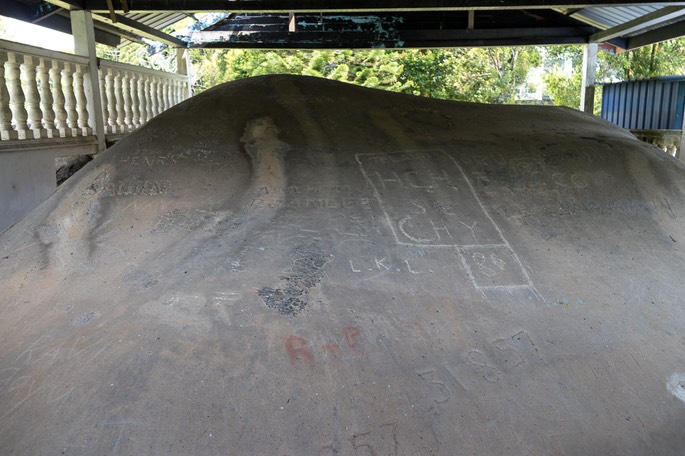
By this time, we were frazzled by the intensity of the Malaysian sun. There was no shade in the church complex and we had walked quite a detour in the wrong direction trying to find this ‘shed’. This spot marks the most southerly location in Peninsular Malaysia of ancient relics associated with the Bujang Vallery era. So now it was time to continue our drive south to Chinese Taiping in Perak. We arrived very tired at our hotel (Novotel) so opted for dinner in the hotel restaurant. Our food was tasty and we would have had a dessert but all the staff had disappeared. Malaysian hotels are a strange beast.

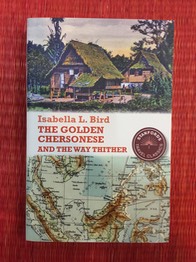
P.S. By all accounts, Sir James Low was a fascinating character who did a lot to document the land he surveyed. According to Isabella Bird’s book “The Golden Chersonese and the way thither”, published in 1883, James Low had a couple of monkeys and a dog as his dining companions, much perfering these to the human options! Her book is a fascinating account of travels around the west coast of Peninsular Malaysia (preceeded by stories from Hong Kong and Canton) at a time when individual women just didn’t do such things! I highly recommend this book.
Here is a slide show of the photos taken on Day 13:
Click here to return to The Great Malaysian Road Trip.
Click here to read Lawrence Gray’s account of The lost cities of Malaya.
Click here to return to Travels in Malaysia 2020.
Click here to return to Helen Gray’s homepage.